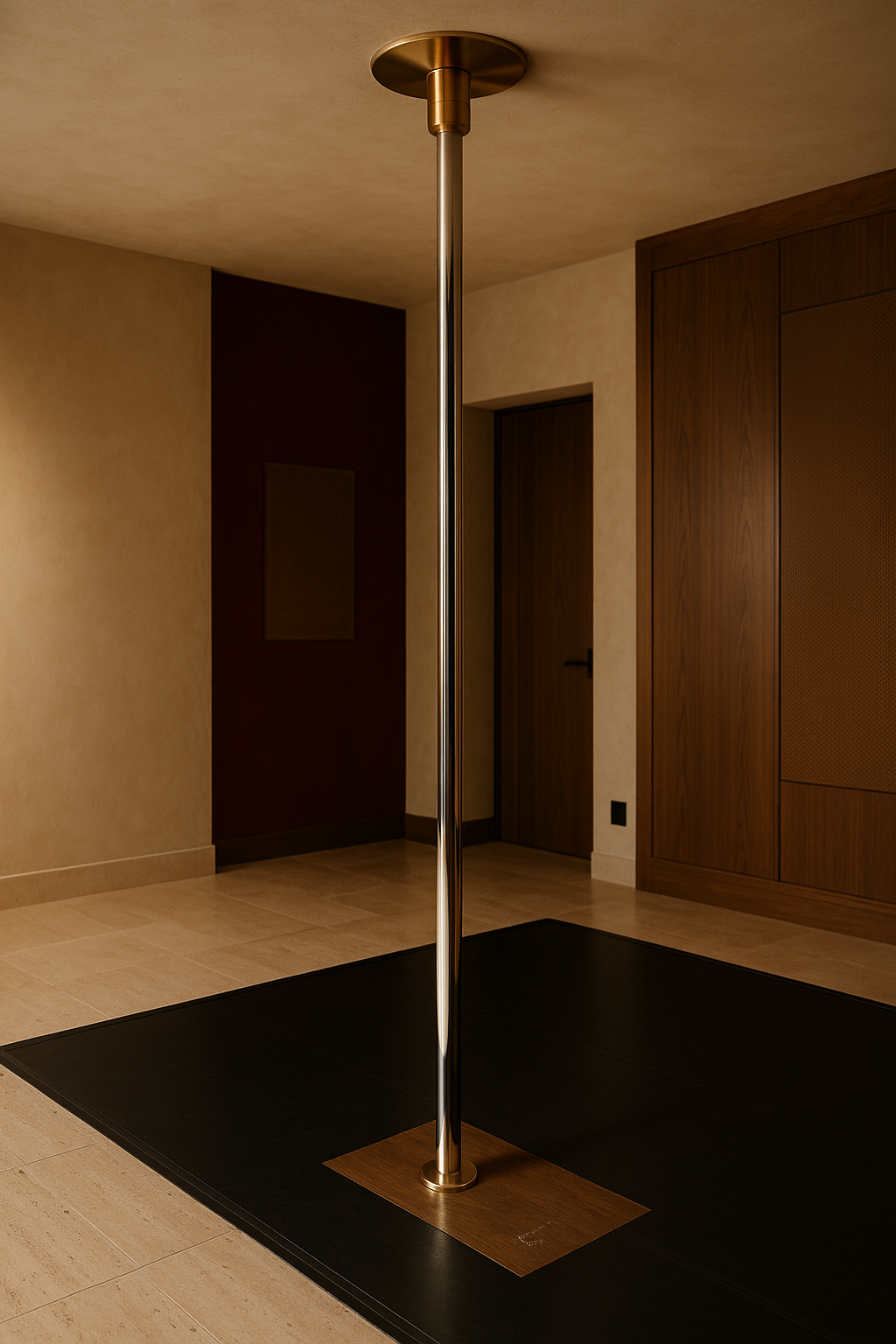
STUDIO NOIR · Safety and Liability
Owner: Trill Walker (CSO) Phase 1, GM Phase 2 (with Director of Facilities + Director of Training co-signed). Standard: exceeds industry minimum. Every safety protocol is auditable. Applies to: pole rigging, contract instructor conduct, member safety, incident response. Phase 2 adds sauna, steam, cold plunge, contrast showers, gym floor, private studios, broadcast events.
1. Philosophy
At STUDIO NOIR, safety is not a hedge against lawsuits. It’s a component of the guest experience. A member who trusts the club trains harder, recovers deeper, and refers friends. Every protocol below exists so that trust is earned before it’s tested.
Nothing in this document reduces legal exposure. It raises the operational floor. Legal exposure is managed through insurance, waivers, and the incident response protocol in Section 8.
2. Rigging (pole)
2.1 Phase 1 design and installation
- All poles installed by a certified rigger (USITT or ETCP certified) with documented load calculations from a licensed structural engineer
- Static poles rated for minimum 1,500 lbs static working load, tested at 2x working load at installation
- Spinning pole bearings sourced from a documented manufacturer with published load ratings; replaced on manufacturer cadence or every 24 months, whichever first
- No aerial silks or hoops Phase 1 (that comes Phase 2 with dedicated aerial rigging + larger fall zones)
- Ceiling reinforcement per structural engineer’s spec (see 04_REAL_ESTATE_BUILDOUT/05_MEP_STRUCTURAL_ACOUSTIC)
- Fall zones under pole apparatus: 6 feet radius, clear of hard obstructions, sprung floor + marley below
Documentation stored digitally with Trill and physically at the studio.
2.2 Inspection cadence Phase 1
Three tiers. All logs retained for the life of the studio plus 7 years.
Daily visual inspection. Executed by the class instructor before each class: - Poles: no marks, no bent hardware, spin action smooth, no play at ceiling collar or floor plate - Mats: no tears, no compression damage, no exposed foam - Any concern → pole out of service immediately, class delivered without pole (movement/mobility work), Trill notified
Monthly hands-on inspection. Executed by the lead instructor with a certified rigger present: - Torque check on all bolted connections to spec - Bearing check on spinning poles, replacement if any grit - Load rating tag audit - Written report signed and filed - Any deficiency corrected before the studio returns to service
Annual load test and structural review. Executed by the licensed structural engineer of record + rigging contractor: - Proof load test on each pole rig at 1.5x maximum anticipated dynamic load - Visual inspection of structural steel, welds, and attachment points - Written report sealed by the engineer, filed with Trill - Any point failing proof test decommissioned until repaired and re-tested
2.3 Apparatus retirement Phase 1
- Any pole sleeve retired at 5 years of service or on any visible damage (whichever first)
- Retired apparatus destroyed on-site. Not resold, not donated, not repurposed
2.4 Class-level safety Phase 1
- No first-time pole member on advanced moves without an intro session and skills screen
- Spotter present for any inversion drill by a member below intermediate
- Instructor-to-student ratio: pole classes capped at 10 members (per 03_CONCEPT_PROGRAMMING/02)
- No jewelry, no lotion, no oils on the pole floor (kills grip). Grip aids sold as small merch (see 11_RETAIL_APPAREL) or provided complimentary in a shared jar at the studio
- Water on the pole surface is a stop-class condition. Studio pauses, pole dried, member dried, class resumes
3. Sauna, cold plunge, steam (Phase 2 only)
Not Phase 1. Full Phase 2 recovery wing safety spec preserved for reference (see below Phase 2 preview).
4. Contract instructor conduct (Phase 1)
- Instructors carry their own professional liability insurance (minimum $1M per occurrence, $2M aggregate)
- Instructors sign a Studio Independent Contractor Agreement (see 14_LEGAL_IP/02_CONTRACT_TEMPLATES)
- Instructors comply with STUDIO NOIR’s brand standards (dress code, tone, punctuality, member greeting)
- Instructors do not date members, do not friend members on personal social media without disclosure, do not solicit private lessons outside STUDIO NOIR (non-solicit clause in contract)
- Instructors report any member injury or incident to Trill immediately
5. Incident response Phase 1
5.1 Immediate response
For any injury or medical event:
- First responder is the class instructor (all instructors CPR/AED certified per contract)
- Any staff/founder on-site radios or calls Trill immediately
- Trill dials 911 for anything more than a minor scrape
- AED (defibrillator) brought to scene by nearest staff (mounted at reception per 07_OPERATIONS/03_HVAC_CLEANING Phase 1 life safety equipment)
- Clear the area, maintain member dignity, screen from other members
- Attend to the member until EMS relieves
5.2 Documentation
- Written incident report within 24 hours (Google Sheets or Airtable), filed by Trill
- Photos of the scene where relevant (no photos of the injured member)
- Witness statements collected on the day
- Report forwarded to insurance carrier within 48 hours
- Report includes: date, time, location, activity, apparatus if any, staff present, action taken, EMS involvement, follow-up plan
5.3 Follow-up
- Personal call from Trill or Taj to the member within 24 hours
- Personal note from Taj within 72 hours
- Follow-up call at 7 days
- Referral to medical partner if the member doesn’t have a preferred provider
- Any equipment involved pulled from service pending inspection
6. Life safety equipment Phase 1
Placement and cadence (cross-referenced to floor plan on file):
- Defibrillator (AED): 1 at reception. Monthly self-test log. Pads replaced per manufacturer schedule.
- First aid kit: 1 at reception. Restocked monthly.
- Fire extinguisher: ABC extinguisher at reception, ABC in the studio. Inspected annually by third-party fire protection vendor, tagged.
- Sprinkler system: landlord’s existing system, verified adequate for our use by GC pre-lease.
- Fire alarm panel: landlord’s existing, monitored by third-party central station.
- Emergency lighting and exit signage: tested monthly.
- Evacuation plan: posted at reception + studio entry, rehearsed with instructors quarterly.
7. Class waiver template
Every member signs a waiver at first visit. Guests sign every visit.
Waiver template stored in the operations system, reviewed annually by RDU counsel. Required elements:
- Acknowledgment of inherent risk in pole and movement activities
- Attestation of physical fitness to participate; obligation to disclose changes
- Medical disclosures (recent surgery, cardiovascular conditions, pregnancy)
- Media release for on-premises photography (opt-out available)
- Emergency contact information
- Consent to receive first aid if incapacitated
- Assumption of risk and release of liability (drafted by counsel per North Carolina law)
- Arbitration clause per counsel’s guidance
- Signature, date, staff verification
Waivers stored digitally in Mariana Tek member records + encrypted backup. Retained minimum 7 years past member’s last visit.
8. Medical partner referral
STUDIO NOIR does not diagnose or treat. Referral partners on file with Trill:
- Sports medicine physician group in the Triangle metro (Duke Sports Medicine and UNC Sports Medicine as anchors)
- Aerial/dance-specific PT
- Cardiology consult (for members wanting pole clearance beyond baseline screening)
- 24-hour urgent care partner within 3 miles
Referral is offered, never required. Member decides.
9. Insurance Phase 1
- General liability + participant liability: minimum $2M per occurrence, $4M aggregate
- Property insurance: covers buildout + equipment
- Cyber insurance rider: small business version
- Business interruption insurance: covers weather closures, unexpected events
Full insurance package sourced through commercial insurance broker with hospitality/fitness experience. Broker retained annually.
Insurance premiums roughly $500-800/mo Phase 1. Fully accounted for in 05_FINANCE/00_STARTUP_BUDGET.
10. Contract instructor training and currency Phase 1
- CPR and first aid certification current for 100% of contract instructors (verified at contract signing)
- Certificate copies on file with Trill
- Annual refresher required as condition of contract renewal
- Any pole safety incident triggers a review of the involved instructor’s protocols
- Instructor removed from schedule pending review
11. Audits Phase 1
- Monthly internal review by Trill against this document. Findings logged.
- Annual insurance carrier walkthrough at renewal.
- Annual load test verification by structural engineer (see Section 2.2).
- Any Level 4 incident triggers an immediate audit of the specific system involved, before that system returns to service.
Phase 2 adds third-party operational and safety audit annually.
12. NEVER
- Never open a class with an outstanding rigging deficiency
- Never let a first-time member try advanced pole moves without a skills screen
- Never let a class run over capacity (10 members max)
- Never delegate incident notification to Taj — always Trill first
- Never publicly discuss an incident. All external communication runs through Trill and, where required, counsel
13. Phase 2 safety and liability (preserved for reference)
Phase 2 flagship adds all of the following, plus the aerial + recovery wing infrastructure. Full Phase 2 safety spec preserved from earlier planning:
Aerial safety: - Aerial silks + hoop rigging: minimum design factor 10x anticipated maximum dynamic load per point - 12-foot minimum fall zone radius per aerial apparatus - Impact-absorbing crash mats at every hoop or silk station - Silks retired at 3 years of service or immediately on any chemical exposure, tear, or fall event - Aerial instructor-to-student ratio 6:1 - No unaccompanied aerial in private studios
Sauna: - Temperature range 175-195°F, monitored continuously by wall probe with digital log - Humidity 5-15% for traditional dry sauna - Standard session cap: 20 minutes (sand timer at each door) - Medical screening at membership onboarding (cardiovascular, pregnancy, medication flags in profile) - Cool water and cool towels at exit - Warning signs response protocol (dizziness → attendant exit assist, cool towel, water, monitor 15 min; if unresolved 5 min → escalate to MOD, apply O2 kit, dial 911; cardiac event → 911, defibrillator, CPR)
Cold plunge: - Temperature 38-45°F, circulation 24/7 with UV + ozone treatment - Chemistry logged 4x daily (open, midday, evening peak, close) - Free chlorine 1.0-3.0 ppm, pH 7.2-7.6, ORP above 650 mV - Any parameter out of spec closes the plunge until corrected - Medical screening required, contraindications (uncontrolled hypertension, Raynaud’s, recent cardiac events, pregnancy without physician clearance, cold urticaria, arrhythmias) - Session cap 5 minutes per entry, 3 rounds per session with contrast - No solo entry, attendant always within line of sight - No alcohol in 4 hours preceding (bartender briefed to soft-flag members ordering wine before booked recovery)
Steam room: - Temperature 110-115°F, 100% humidity - Session cap 15 minutes per entry - Same medical screening as sauna - Aroma canister with medical-grade eucalyptus/cedar blend (never member-supplied)
Contrast showers: - Presets: warm 100°F, cool 65°F, cold 55°F - Standard protocol 3 min warm / 30 sec cool, 3 rounds, finish cool - Preset panels tamper-resistant, grab bars, non-slip flooring
Gym floor and private studios: - Free weights limited to 100 lb dumbbells max on open floor; heavier only in strength studio with coach - Barbells inspected weekly (sleeve wear, collar function, knurl integrity) - Racks bolted, safety pins in place, no free-standing squat without spotter - Cardio equipment on quarterly preventive maintenance contract - Private studio bookings require member acknowledgment of no unaccompanied training on aerial
Life safety equipment Phase 2: - Defibrillators at concierge desk, recovery deck, training floor mezzanine - O2 kits at concierge desk and recovery deck (cylinders logged monthly, regulators serviced annually) - Fire extinguishers ABC per zone + additional K in café - Full sprinkler system quarterly inspection - Fire alarm panel with 24-hour central station monitoring - Fully staffed emergency response with MOD
Staff training Phase 2: - CPR + first aid certification 100% of floor, recovery, and concierge staff - Rigging inspection training for Director of Facilities + floor leads (annual refresh) - Water chemistry certification for recovery attendants (2-year refresh) - Fire evacuation drill quarterly - Incident response tabletop exercise every 6 months
Full Phase 2 safety and liability spec rebuilt in 2028 alongside flagship staffing and buildout.